
Home | Pioneers | Contact Us | Copyright/Disclaimer
Bega
District Prosperity Lies in Dairying.
(Copied from Bega’s Century of Progress 1857-1957 by Barbara Adams [davida8-at-bigpond.com])
The prosperity of the entire coastal strip depends, in the main, upon the prosperity of the dairy farmer.
Since the days of the very early settlement, the dairying industry has built up from a very small beginning.
The early settlers brought a few head of stock with them, probably they were Illawarra Shorthorns- a breed that like Topsy, “just grew”. When butter first meant money to the early pioneers, it was the age old process that made it - churning. But the techniques were, shall we say a little different.
The milk was set in big pans and cream skimmed off. It was churned into butter and placed in a keg. But it took time to fill the keg, and the butter was getting old before it was full. When eventually filled, it was sent to Sydney and sold at perhaps sixpence, probably less, per pound, and was often so rancid that it had to be thrown away.
The development of the dairying industry was hard. Many of the early settlers had very little capital and droughts, a feature of the Far South Coast weather, were just as severe in the early days.
The “Bega Standard” of 1887 said: The drought took away first his savings, and next his cattle.
In that year stock died of starvation all over the district, and the path back to more prosperous times was not easy and was gained only by good rains that fell in the following seasons.
CHARLES PARBERY, the father of Mr. Herb Parbury bought the first Ayreshire bull to the district, JOHN FARRAHER, of Candelo bought the first Jersey. The first shorthorn came with the first settlers.
The first separator did not arrive in Bega until 71 years ago, when it was bought here by DANIEL GOWING. Slowly the new machinery was accepted and the old style of milk setting discarded.
The butter keg was also discarded, and to JONAS ALCOCK, of Bemboka is accorded the honour of using the first butter box.
In 1894 the NSW Creamery Company erected a factory at Bega, where the main building is still to be seen near Yarranung. Milk was brought to this central factory, separated and made into butter. The company erected other factories over the district. Dairy farming was becoming the main income earner on the Far South Coast.
The thought of Co-operative factories was soon translated to fact. In 1893 the first of these was opened at Wolumla. They soon followed elsewhere, some for cheese manufacture, others for butter.
In 1900 the Bega Co-operative Creamery Company opened its first weatherboard factory at North Bega. The building cost 800 pounds but the debt was liquidated within two years and Bega’s butter was then winning prizes for its quality.
The early directors. Messrs. T.J KELLY, T. D’ARCY B.GOWING J.OTTON AND J.T. ROGERS urged the value of co-operation so well that within a year the factory’s output had almost trebled and reached 600 tons.
Progress was slow for the next 25 years but 1924 had seen the new butter factory built by the Bega Co-operative Society at North Bega and production from it reached 887 tons.
Earlier the farmers having learned of the advantages of co-operation, commenced their Bega Co-operative Store, in Carp Street, Bega, or more correctly at the intersection of Carp and Auckland Streets. The store commenced trading on March ist 1920 with MR. F.S.GOETZ as Manager and was successful.
Rebates and discounts were given to shareholders, who purchased goods at the store, the fee to become a shareholder was fixed at five pound or five one pound shares.
In 1920 the turnover was 16000 pound. In 1940 it was 101,000 but in 1946 it had reached 503,000 pounds
Meanwhile the early butter factory factories that had been established, all of which were co-operative, continued to expand their production, and located at PAMBULA, CANDELO, BEMBOKA COBARGO and SOUTH WOLUMLA, helped develop these areas.
Repeated proposals for the establishment of one big factory at Bega were always rejected by the smaller factories, who refused to be absorbed by one big organization
The early 1920’s saw the first attempts at large scale pasture improvement, bit it was not until the 1930’s that the use of super phosphate was recognized as essential,
JOHN L. GREEN of the NSW Department of Agriculture came to the district with the slogan “Super and sub mean success” Light country in the Cobargo district was converted and production commenced to rise, so that in 1932 Bega Factory produced1,111 tons of Butter.
But the 1930 also brought economic collapse, and the dairy farmer received only 63/4d for butter. Pig markets collapsed. Large porkers were selling for one pound and heifer calves for ten shillings.
All over the countryside, men looked for work, and the wages paid to them on farms were seldom more than a pound per week and keep, and very often less.
It was a period of real hardship for the farmer, only made easier than it was for those in the cities because living on the land was cheap, and nature in its bounty meant good seasons.
When war came in 1939 butter output in Bega had reached almost 1400 tons and cheese at district factories reaching high figures. The war brought many problems.
The farmer’s sons went off to fight in it and 1941 saw a major drought. Stock died all over the district. Many farmers ran deeply into debt to keep their herds alive.
The “Bega Standard of 1887” could have described the 1941 when it said
“The drought took away his savings and next his cattle”
The war over, advantages came. There was peace and growing population. There was a better price for butter. New Machinery came to the district and bulldozers were used for land clearing.
Milking machines, which were found very desirable during the war, because of lack of labour, became accepted on almost every farm.
The Development of the Bega Valley County Council’s hydro electric scheme in the 1940’s sent electricity out to the farms and permitted all the amenities that go with it, to be taken to them.
The “Bad old days” of hand milking no electricity and poor communication were ending for very many farms. School transport was arranged for children. Better roads came over the district and tractors became more plentiful on the farms. The use of super phosphate was recognized as the key-with water- in pasture improvement. Dairy farming had passed its war time difficulties.
With confidence in the future, the Bega Co-op Society Ltd, built its own new store in Auckland Street in 1949.
In 1956 the Society installed a milk packaging plant, so that with its cheese manufacture that it began in 1955 and its equipment to treat skim milk,its manufactures can be diversified.
The dairying industry faces many difficult problems today. Prices for butter having fallen to a very low figure in the United Kingdom, where the surplus Australian production is sold. The realization on this market is completely unprofitable. Attempts to find more profitable outlets elsewhere have in the main failed. Australian consumption( per capita)
Is falling but the overall consumption is increasing because of a growing population.
Today almost all the dairy breeds are Jerseys. That they are high quality stock is best illustrated by the recent Bega Jersey heifer sale when 1,725 head were sold on February 18 this year and buyers came from many parts of NSW and Victoria to buy Bega Valley Stock
The history of the development of the Bega Valley wouldn’t be complete without a tribute to the pioneers of this district, who, though few in number, had the foresight and faith in this district to call a public meeting the July 15 1899 from which was created
The Bega Co-operative Society Limited.
From a nucleus of twenty-eight suppliers in December 1900 and a share capital investment of 2687 pounds The Society has grown to a membership of 2600 as at December 1956, with share capital invested at 92,000 pounds assets, exceeding 375,000 and a yearly turnover of factory products and retail trading in excess of one million
The Society is an indication of what can be done on a co-operative and collective effort and stands as a humble testimonial to those early stalwarts who had the faith and courage of their convictions.
It would be fitting that the names of those present at the first public meeting, be preserved
JOHN D’ARCY (Senior) JOHN OTTON
J. B. D’ARCY (Junior A.L.MANNING
JOSHUA BRITTEN JOHN BRITTEN
T.J KELLY THOMAS COCHRANE
HENRY OTTON E.H. SCOTT
JOHN TAYLOR
P.H.WOOD
J.J.RICHIE
BEGA means, in the Aboriginal tongue, "beautiful,' -and the word is most truthful as well as expressive, it proves,' like many other native names, that the blacks were by no means destitute of taste and feeling In fact many of their names show a keen appreciation of scenery, and express, in a Single word, the Characteristic features of the locality designated. All visitors concur in the opinion that no place in the colony so nearly approaches in its external features and scenic peculiarities the beautiful-English county of Kent. View it from any of those neighbouring hills and the scene is striking. Here are rivers whose courses are marked by rows of trees surrounding it on three sides ; lanes leading to the town from all points ; and churches on the hills. Beyond the river, on one hill - is Captain Campbell's fine-looking house and the Yarraning property. On another – is Daisy Bank, Mr John Dawson's and other buildings, with Tarraganda between. Dr. Lang, after visiting this district; truly said: "The Bega country is decidedly the finest I have seen in New South Wales. It is beautifully diversified with hill and dale; lightly wooded in its natural state, and the trees of an umbrageous character, quite unlike the spindle-shanks we find about Sydney. It is equally adapted for pastoral as well as agricultural purposes, the soil, even to the tops of the hills, being of first-rate character. On the whole, the Bega country has more of an English aspect than perhaps any other part of the colony and the only thing wanting to complete the resemblance is the squire's house and grounds every mile or so. But this will all come in time, for to use tho tailor's phrase, 'there is the makings of a regular English county in Bega, and no mistake.' "This opinion was given by Dr. Lang nearly six years ago, and the last prediction has partially come true.
The township of Bega was formed about seventeen years since, when tho first land sale took place. Allotments forming a township on the southern side of the river were sold before this, but the northern side was soon considered the most desirable, and soon became the most populous-only a few houses being erected on the first site. As Bega is so little known in the other parts of the colony, I must first state that the town is situated on the Bega River, about 250 miles south of Sydney and the sea coast is about eight miles distant in a direct line. The population of the town, according to the last census, was 887, but this includes a few houses in the suburbs. However there has been a wonderful natural increase of the population since, for which allowance must be made, and which would possibly bring the population up to a thousand, or very near it.
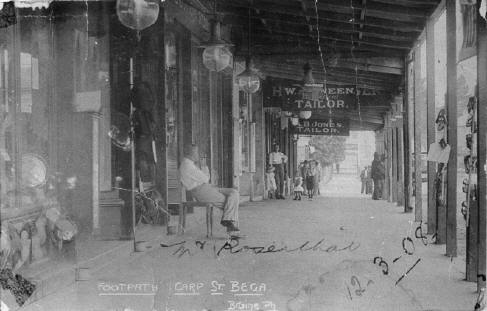
Bega has four churches, two schools, two news papers, a School of Arts, a bank, a court-house, and a dozen magistrates, a lawyer, a licensed surveyor, a doctor, a telegraph and post-office, three hotels, five stores and two tanneries. The principal streets of Bega are Church, Auckland, Carp, and Gipps streets. Of the churches there are two wooden, one stone, and one brick building. The Church of England is a wooden building, in the centre of the town. The want of a new church is very much felt, but I am given to understand that it is the intention of the church wardens, and the present generally-respected and indefatigable incumbent, the Rev. A, D. Faunce, to shortly make a move by raising subscriptions, which will undoubtedly be crowned with success, as the congregation, or perhaps I should say, the inhabitants, generally will respond. It is worthy of remark that all four churches in Bega were erected by the joint subscriptions of the Episcopalian, Roman Catholic, Presbyterian, and Wesleyan bodies, who cordially assisted each other; so in the erection of the new Church of England much assistance, it is confidently anticipated, will be given by the other denominations. About a mile from the centre of the town there is already, in connection with tho church, a very well built brick parsonage, erected by subscription. It is situated on a commanding position, and the glebe land consists of about sixty acres, the gift of Mr. T. S. Mort, whose benevolence was further extended by a substantial subscription to complete the building.
The Roman Catholic Church is in the best position -almost on the top of the bill-overlooking the town ship below, and at the Eden, Merimbula, Candelo, and Kameruka road entrance. It is, however, but a plain wooden structure, and beside the church services on Sundays, it is used as a Roman Catholic Denominational School during the week. A new church is urgently required. The Rev. P. Slattery officiates throughout this extensive district. At the side of the Catholic Church there ÎB a capital presbytery just completed. It is built of brick, is well-furnished through out, and a garden is being formed in front,
The Wesleyan Church is a brick building, rather small, but neat in appearance. It has only been completed (free of debt) a short time since, at a cost of £450. The Rev. Matthew Maddern is the Wesleyan clergyman of the district.
The Presbyterian Church is built of stone, with shingled roof - also of recent erection - at a cost of about £500. It is a pretty edifice, and is situated on the slope of the hill in Church Street. Mr. Thomas Moorhead was tho contractor for the erection of this building. The Rev. W. Thom is the minister for the town and district generally. This "parish" of the Bega clergy men is another immense one, and may be said to extend from Cobargo to Genoa (or Jenoa) over 100 miles in length, and over thirty-five in breadth.
Next in importance come the schools, which often deserve so much and receive so little attention from the public There are certainly exceptions, as in Bega, but tho majority of masters may work and slave for year after year in a school without the slightest interest being taken or encouragement being given. None require it more, therefore I endeavour to give the inspector's reports the widest circulation by publishing them as often as possible. By the present unwise arrangement, these reports are seldom seen by the teachers, and never by the parents. It must be interesting to the latter to hear how the school in which their children attend is spoken of by those whose duty it is to report upon it. The majority of the schools in the colony are now being conducted in a most satisfactory manner. Teachers, who take a pride in their schools, invariably feel honoured by the visits of strangers, and delight to prove the superiority, and show what their pupils can do. In Bega this is particularly the case.
The Public School is a brick building, looking rather old and mouldy, and having a perfectly disgraceful residence for the teacher attached. This condition of the residence is owing it is alleged, to the low state in which the school had fallen in the estimation of the public by the misconduct of a previous teacher, whom the impartial inspector condemned in a manner which 'elicited the approval of the community. This incompetent, and by an inspector's report, "brainless individual," resigned and left the Council's employment some months since, and in his place came a gentleman under whose management, I am happy to state, a glorious revival has taken place, giving the inspector an opportunity of reporting most highly of the new management, and as it should do, awakening up the people to a sense of importance of keeping a good master. On the occasion of my visit, there were seventy-four children in attendance, and the number on the roll was eighty-six. The average attendance was also represented by the first number, which is thus shown to be very high. Mr. Oswald Welby is the head-master, and he is assisted by Miss Welby. The pupils, who presented a most pleasing appearance, were examined in grammar, including reading and analysis, arithmetic, geography, geometry, and algebra. In all these branches the pupils were remarkably proficient, and I admired very much the practical nature of the instruction. The writing also was clean and the figures were commendably neat. In the infant and smaller class-rooms I found Miss Welby taking any amount of pains with the little ones, who were exceedingly anxious to excel each other in their - simple lessons. The discipline of the whole school was well maintained, and the children were very orderly. Where the whole of the pupils acquitted themselves it is impossible to do anything but give the names of those whose proficiency came immediately under my notice in one or more of the subjects in which they were examined. They were :-Masters Gowing, Thomson, O. Herne, Percy Berne, Frank Jones, Robert Sharpe, George Moon; and Misses Esther Prescott, Isabella Prescott, Helen Thomson, Ann Galli, Eliza Anderson, Jane Underhill, Edith Braine, and Alice Britten. W. McIntyre, Esq, the inspector of schools for the district, at the conclusion of a severe examination held at the beginning of the year, reported as follows: “The proficiency of the third class ranges from very fair to excellent, and the general management of the school has been much improved since last inspection, held in January, 1870." The report of last inspection under a former master may be judged from tho following extract:-" The attainments of the pupils in all the classes are much below the standard of proficiency required. The pupils are disorderly, and the school-room floor is in a filthy condition. The apparatus and books are not kept in an orderly manner. The general management of the school requires immediate attention." Contrasting these reports, the result of a change of masters, must be gratifying to the general public. The following gentlemen are the members of the local board:- -Messrs. W. D. Tarlinton, J.P., F. Berne, J.P., J. Heady, W. Heath, E. E. Bligh, and D. Gowing.
Since writing this I have learnt that the local board has deemed it necessary to apply for increased accommodation, and accordingly a girls' school has been granted in connection with the Public School, and will be held by Miss Welby in the wooden building at present used for the services of the Church of England in the town.
The Roman Catholic Denominational School held in the church, is under the management of Mr. O'Grady, a gentleman of considerable ability, and the presence of a number of children of other denominations receiving instruction, shows how highly the education there received is appreciated. There were seventy-two children on the roll and over fifty in attendance, when I visited the school. The examination in grammar, arithmetic, geography, &c, was very severe, and the children’s' replies to every question showed how well grounded they were in the subjects taught. Amongst those who distinguished themselves during the examination by answering difficult questions, I noticed the following:-Mesdames Heady, McNamara, O'Neil, and Leonard; masters D'Arcy, Beck, Brown, Manning, Underhill, and Kirby. The writing was excellent. The following gentlemen comprise the local board: The Rev. P. Slattery, Messrs John D'Arcy, J.P. W. D. Tarlinton, J.P. P. Kirby, and M. McNamara.
The School of Arts is a credit to the town. It is built of brick. The interior is decorated with mouldings, and a stage and gallery are also erected within the building. The work has just been completed and the total cost was about L700.
The court-house is also of brick, but it is a poor building, although the Government have lately been patching it up a little. The gaol is at the back of the court-house, but it is wanting in both security and convenience. The court day of Bega is every second Tuesday. Curiosity prompted me to attend on one occasion during my visit, and there were four magistrates on the bench. The small court-house was filled by the inhabitants listening to a sly grog-selling case. The case resulted in a fine of L30, though the defendant maintained that he was merely having a social party at his house, and invited a few, whom he thought friends, and he only charged them for cakes and lollies, not for the drinks. The discussion of this case was kept up for a week or ten days, so unusual was it. Sergeant Cleary is in charge of the local force, but they number only three.
The post and telegraph office is nearly opposite the School of Arts, and is a very small building for the large amount of business transacted by Mr. Baker, assisted by Miss. Baker, the latter exceedingly clever as a sorter of letters, and reputed to be the most correct lady telegraphist in the colony. Mr. Baker has been many years in the Government service; but his health is failing, and in consequence, as I was given to understand he will shortly cease his connection with the postal department. I hope this may be avoided, for the whole district speaks well of him, and I have been generally requested to bear testimony to his courteous and obliging disposition. At all hours - night and day, this gentleman and his daughter have readily delivered letters to your correspondent, and the general public; and with bad mail arrangements, their patience must have been severely tested.
There are a number of societies in the town flourishing, among which are the Oddfellows, a branch of the Holy Catholic Guild, and the Sons of Temperance.
The Bega Jockey Club hold annual race meetings and prizes to the value of two hundred sovereigns have been run for at each of these. A country race meet is well worth seeing, and I have never enjoyed myself so much at Randwick, as I have at Bega. People all seem to know each other, and come from the district in twos and threes on horseback. The ladies are all good horse women, and the course presents a very pleasing appearance on race days. The people, too, are very free and jovial in their manners, and at intervals during the advertised races, hurry sourrys, and private matches come off, W. D. Tarlinton, Esq., J.P., is president, Dr. Shiels, vice-president, Mr. Fred. Berno is hon. treasurer, and Mr. W. Ellis, hon. secretary; and Messrs. C. T. Stiles. J.P., K. E. Bligh, J. Tarlinton, W. Allen, and John Heady, are on the committee.
There is a branch of the Commercial Bank in the town, and Mr. Walker is manager. I believe that a fair amount of banking business is done.
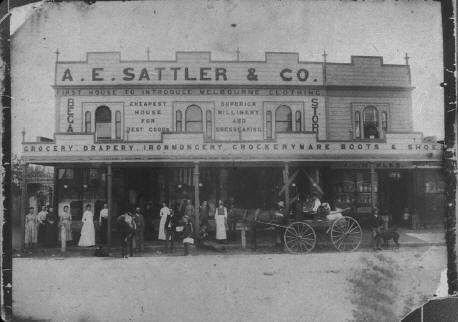
The principal stores are those of Messrs. E. M. Broad, J.P., Fred. Berne, J.P., W. Ellis, James Thomson, and A. Sattler. There are only three hotels in the town, viz., J. Rixon's Commercial, Underhill's Bega Family Hotel, and Mrs. White's Victoria Inn. There are two chemists, Mr. W. H. Hopkins, and Mr. Hearne; two tanners, Mr. Spence, in particular, doing a large business; two saddlers, Messrs. J. W. Lenehan and J. M'Phee; one plumber and tinsmith, Mr. C. H. Anderson; three butchers, Miller, Underhill, and Powell; and, curiously enough, no baker; though the want of the latter is said to be much felt. Writing, of butchers reminds me that game in the shape of wild duck, teal, &c., was so plentiful this year that it is said to have made a difference of a bullock a week to the butchers. Before the hotel door I was staying at, in the centre of Bega, at sundown one evening, my attention was called to a paddock, not fifty yards off, in which were feeding two or three hundred wild ducks, which had roamed up from a lagoon lower down. The paddock was literally swarming with them.
In this young township of fifteen years growth, land has become very valuable, and I know that for a half acre allotment £200 was refused. Suburban lands realize from £2 to £4 per acre.
Every town has its wants, but the more important in Bega is the want of a municipality. The streets in wet weather are very bad indeed. Efforts have been made from time to time, but in almost every instance without any satisfactory result, as counter-petitions from persons who fear taxation are always got up.
Before concluding a description of the township I append the following official directory for public information:- Magistrates : Henry Wren (chairman), Edward Haslingden, Robert Ritchie, John D'Arcy, Charles F. Stiles, W. J. Lane,, William McGregor, R. T. Kirby, Fred. Berne, R. M. Broad, John Jauncey, Esquires. John Davis, Esq., is Clerk of Petty Sessions, and Crown Lands Agent. Clergy: Church of England, the Rev. A.' D. Faunce; Roman Catholic, the Rev. P. Slattery; Presbyterian, the Rev. W. Thom; Wesleyan, the Rev. M. Maddern. Dr. Shiels is the only medical practitioner, and he is also coroner. Mr. Thomas Rawlinson is the only resident solicitor; and Mr. John Heady is the licensed surveyor of the district.
I next started for Tathra, the nearest shipping port of the district, about nine miles off. After getting out of the town I passed; the parsonage and a few farms. Going down a slope a scrubby rise opposite was pointed out as Murdering Range; so named in consequence of the murder of a stockman, by a blackfellow, for stealing his gin or lubra. A little further on was pointed out the spot where, years ago, a blackfellow, not believing in the effect of a gun-shot, foolishly exposed his open breast, and invited a whiteman to shoot. The gun was presented and fired, and the blackfellow made a jump in the air, and fell dead."
A few miles beyond this I turned to the left, and a the end of a quarter of a mile found myself at Warragubra, the property and residence of Messrs. Allen and Woods, who are, without doubt, two of the largest agricultural producers in the district. Their properties at Warragubra, Jenkins's Flat, and Taraganda, comprise about 3000 acres, principally a rich agricultural land, having a river frontage on every farm. The Warragubra Farm is one of the best, and consists of nearly 1200 acres of land. A large amount of work has been done here by these true yeomen, and they have changed a heavily-timbered and scrubby flat into beautifully clear fields. This year 220 acres have been placed under maize, and forty acres under grasses at Warragubra, and about 120 acres of maize and 60 acres of grasses have been sown at their other farms at Jenkins's Flats and Tarraganda. Near the comfortable house of Mr. Allen there are capital farm buildings, including a large barn and milking-shed, dairy, dray house, stables, &c. About 120 cows are being milked on the farm this season. The great feature of the place is the immense piggery, and an idea may be formed of the trade done with Melbourne when it is known that Messrs. Allen and Woods have sent over 1100 pigs to the Melbourne market by boat from Eden this year. These were valued at considerably over £2000. The fattening operations may be judged from the large quantities of corn that are grown and consumed. Passing through some meadows where four or five Millionaire foals and a Vanquish filly were kept, I came to a vineyard of about five-acres. The whole of the vines are on wire trellis work. It is under the care of a person who thoroughly understands vine cultivation.
About a mile and a half from Allen and Woods's I again turned to the left into Mr. Gowing's farm - an estate acknowledged to be worked on the most approved farming principles. Mr. Gowing ranks among the few in the district who have had experience in the home country. He has also been farming in New South Wales since 1841. He possesses altogether 3000 acres of good land, of which there are nearly 1000 acres of rich alluvial soil. This year 400 acres are under maize, and he is also a large pig-breeder, having dispatched between 600 and 800 pigs to Melbourne during the past season. Mr. Gowing has suffered most severely by floods which swept a fine residence away, and caused serious damage to fences and out buildings. About a quarter of a mile from the house he has a substantial mill erected, and nearer still stone, stables and store-rooms. The most prominent feature of the place is the nice garden which is immediately before the present residence. It is artistically arranged, and had in it camellias in bloom, roses of every kind, "French May" hedges, and other nice shrubs and flowers, while rising in the centre was a fine Norfolk Island pine. Below the garden was an immense orchard, having every kind of fruit. My time did not permit of a visit to Mr. Gowing's saw-mills, though samples of the -sawn timber spoke for themselves. This estate is called Jellat Jellat.
About half a mile further, I again turn off the road, this time to the right.- to visit an equally fine estate, the property of Robert Ritchie, Esq., J. P. Spread before the eye are hundreds of acres of rich, alluvial deposit, and the scenery is in reality splendid. Skirting green field sown with prairie grass and clover, and meadows, in which quiet cows were grazing, was a fringe of low hills, which bounded tho estate, and lent a pleasing effect to the scene. Over two hundred acres are under cultivation this year, and large dairying and fattening operations are carried on. While accompanying Mr. Ritchie over these rich fields, it came under my notice, and is deserving of mention, that he is a thorough believer in good drainage, and before us were results; for large sums of money had evidently been expended in constructing these capital drains intersecting the lands. A large extent of land in artificial grasses had also been sown, which was springing up wonderfully. Passing some capital stock, the increase of imported bulls, we next visited tho dairy which is a well-constructed building, fifty feet by twenty, and has a shingle verandah all round, to secure fresh draughts of air. In the milking season there are from one hundred and fifty to two hundred and twenty cows milked daily. The churn is on the box principle, worked by horse-treadle motion. A fine barn, perhaps the best in the district, next occupied my attention. It is eighty feet long and about twenty-five feet wide, so constructed as to admit of a loaded dray passing through it. Huge pillars and posts support it throughout, and the pillars are driven six feet in the ground. Farming implements, on the most recently improved principles, next claimed attention, foremost among which were Horne's Coulter ploughs, maize sowers, &c, imported direct from England to Mr Ritchie's order. I should mention that this farm sent over a thousand pigs to Melbourne during tho past season. Altogether, the visitor could not fail to admire the pluck and energy of the spirited owner, and his brothers.
Leaving Jellat Jellat, and Mr. Robert Russell's farm a little farther on, a smart ride, through rather a barren country, for five or six miles, brought me to the port of Tathra.
Tathra harbour is the property of the Crown, but is under the control of trustees : Messrs. D. Gowing, W. Allen, F. Berne, John D'Arcy, and John Jauncey. The harbour is nearly two miles across, and exposed to the north-east winds; consequently, excepting in fine weather, vessels cannot call. The pier is sixty feet long, and about fourteen feet across, and the draught of water in fine weather is sixteen feet. lb was erected about eleven years ago, at a cost of £800. The moorings, including anchor, buoys, and chains, cost another £500. There ia also a receiving store here, having upper and lower floors forty by twenty feet ; but neither of these are water-tight, for the sea breaks over and into them in almost every gale of wind. Mr. Henry Sargeant is the storekeeper, and he is a most indefatigable “Old Salt," and for a good yarn can be backed against the world. A new store is urgently required at Tathra, but the trustees complain that they have no money to lay out; not even to repair the road from Bega, which is in a disgraceful state in some places.
Tathra is a free port-that is, it has no wharfage duties, and no rules or regulations are in existence. Persons often monopolize the wharf, and store for weeks and months with their goods, until it pleases them to take them away; but, "first come first served," and others have then to leave their goods out side for want of room. Two schooners, the Gipsy and Ellen, visit the place about fortnightly, and the I,S.N. Co.'s steamer every week, weather permitting. The principal export during the past twelve months has been wattle bark, at the average rate of bags per week; and cheese, 200 per week, beside small quantities of butter and bacon.
If Tathra is to be kept up, it would be advisable to at once put tho wharf and store in serviceable condition, and to make a better approach, or teams will tumble into the sea in wet weather. I am certain that a few more stiff gales will carry away the store, which is already much undermined.
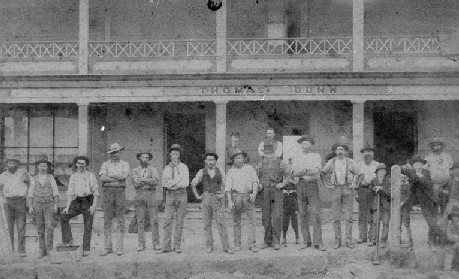
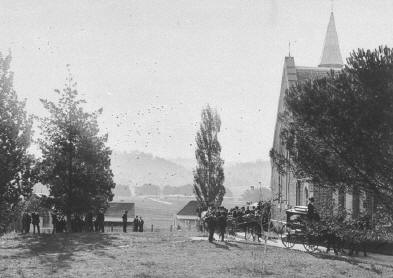
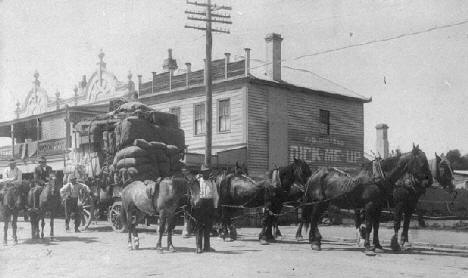
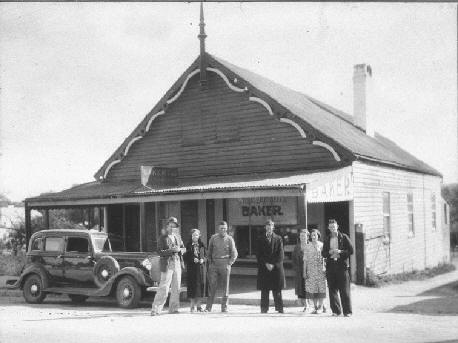
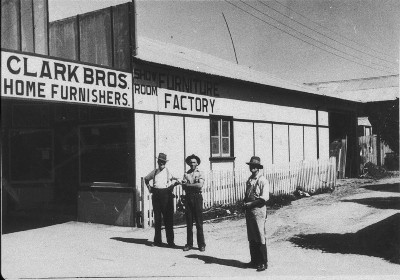
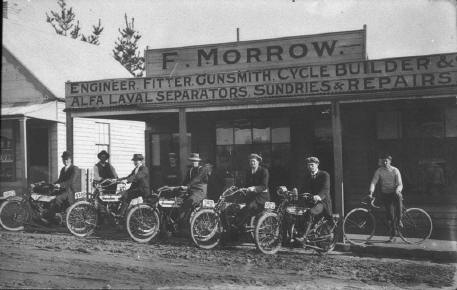
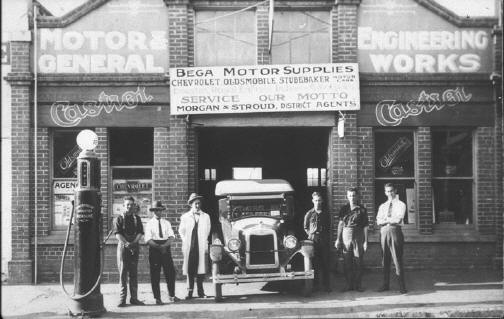
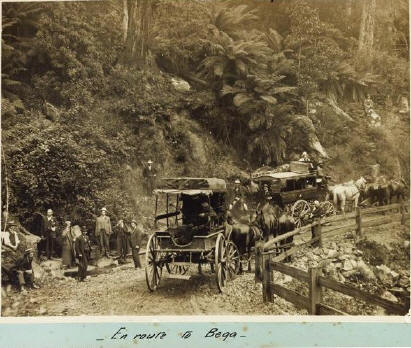
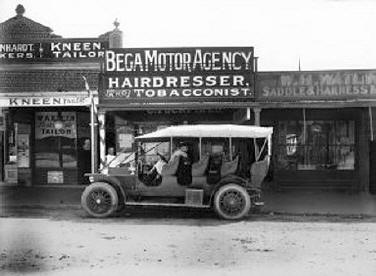
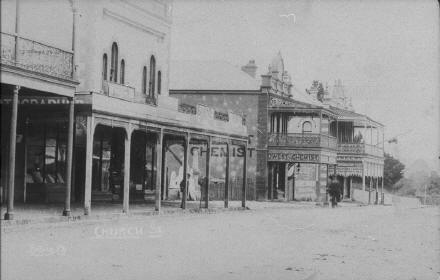
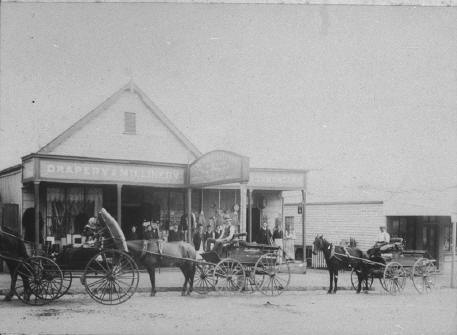
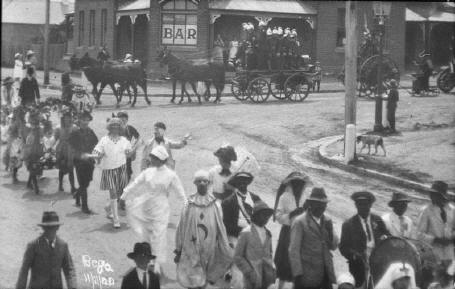
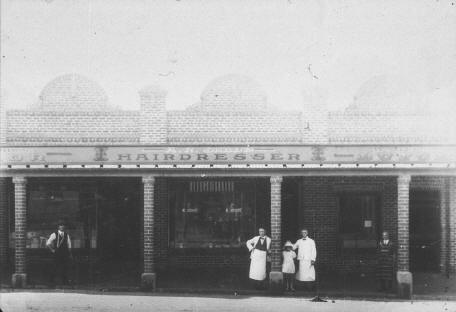
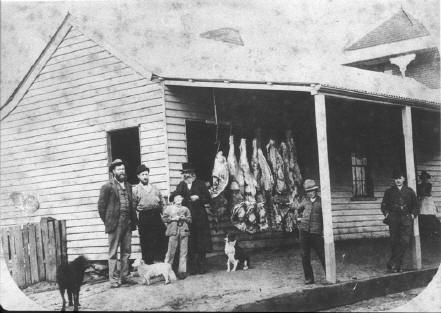
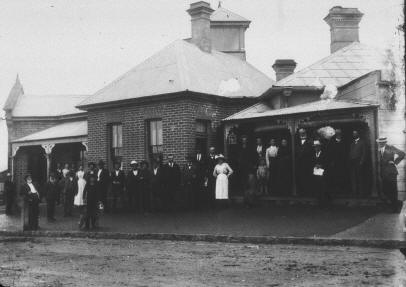
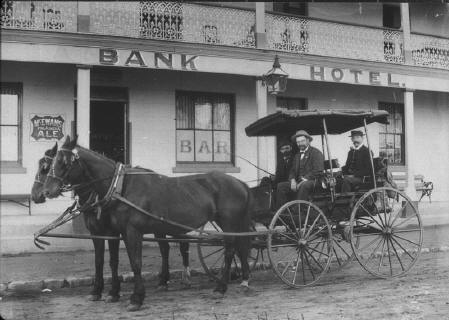
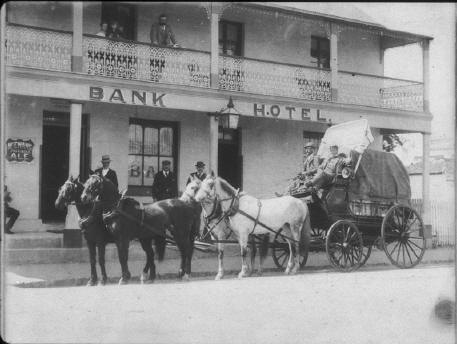
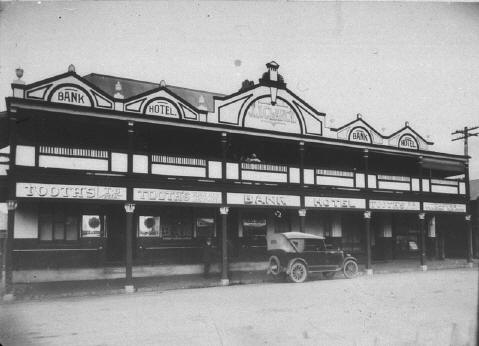
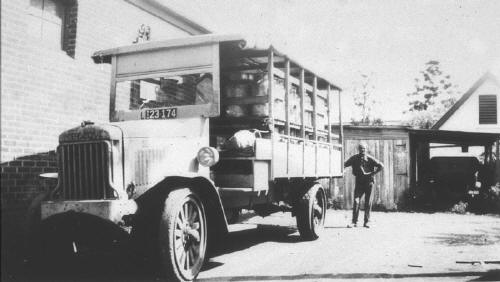
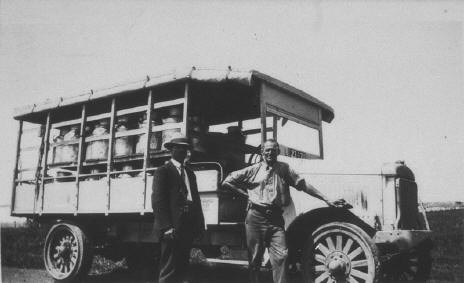
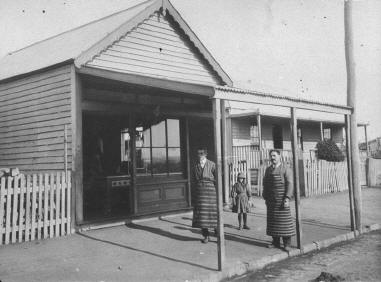
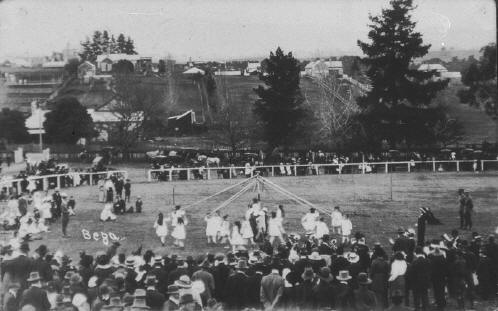
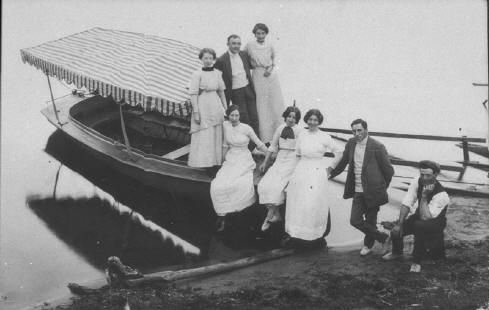
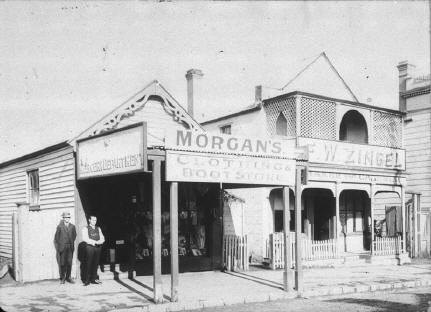
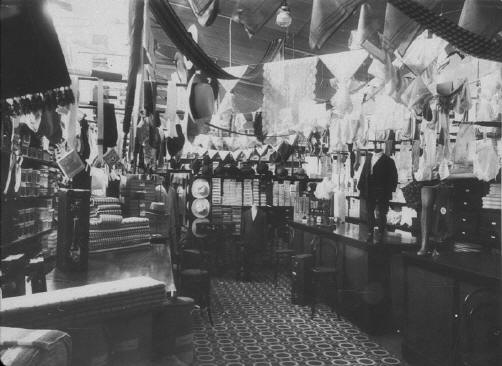
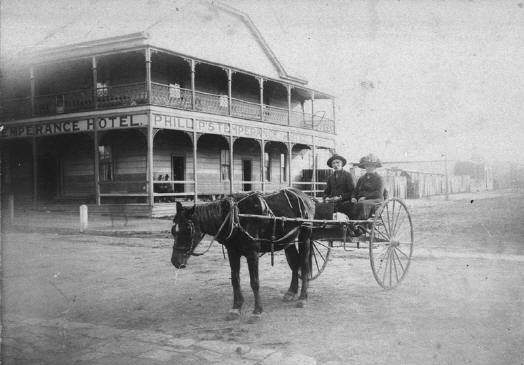
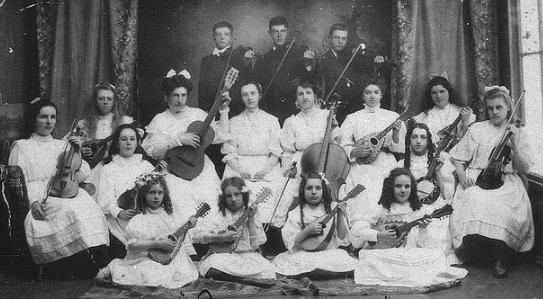
Bega scenes supplied by Judy Richards
 |
 |
 |
|
|
|
 |
 |
 |
|
Baker Shop, Auckland Street |
||
 |
 |
 |
 |
 |
 |
 |
 |
 |
|
||
 |
 |
 |
|
||
 |
 |
 |
|
||
 |
 |
 |
|
||
 |
 |
 |
 |
 |
 |
|
|
|
 |
 |
 |
|
||
|

 Monaro
Pioneers
Monaro
Pioneers